
Most commercial insurance plans cover teen mental health treatment, including therapy and structured programs, when a clinician documents that the care is medically necessary. What a family actually pays depends on the plan, the deductible, and whether prior authorization is approved. Programs typically handle the authorization as part of admission.
Cost is the question most parents have and the one they are least comfortable asking first. It is a reasonable thing to want answered before anything else. Here is how coverage usually works, what to ask, and what the options are when insurance is not an option.
Does insurance cover teen mental health treatment?
In most cases yes, for the full range of care. Weekly therapy, intensive outpatient programs, and day programs are all covered by most commercial plans when a clinician documents medical necessity.
Coverage differs by plan type. Commercial plans through an employer or the marketplace generally cover behavioral health. Medicaid covers it, with its own rules about which providers participate. Self-funded employer plans set their own terms, which is why two people at the same company can have different answers.
The practical first step is the same in every case. Call the number on the back of the card and ask about outpatient behavioral health benefits.
What is mental health parity and why does it matter?
Federal parity law requires health plans that cover mental health to apply standards comparable to those they use for medical care. A plan cannot impose stricter visit limits, higher cost sharing, or tougher authorization requirements on behavioral health than it does on a comparable medical service.
In practice it is a basis for pushing back. If something about your plan’s behavioral health coverage looks harsher than its medical coverage, that is worth raising with the insurer, and in Illinois the Department of Insurance handles complaints.
What does prior authorization mean?
Prior authorization is your insurer approving a level of care before it starts. It applies mainly to structured programs rather than to weekly therapy.
The program usually submits it. A clinician documents what is happening and why this level of care is appropriate, and the insurer approves a set period, then reviews whether to continue.
Two things are worth knowing. Authorization takes time, often several days, so starting the process early matters if the situation is urgent. And an initial denial is not the end, because denials can be appealed and appeals frequently succeed. Ask the program to handle the appeal, since they hold the clinical documentation.
What will a family actually pay?
That depends on three numbers in your plan, and it is worth knowing all three before you start.
Your deductible is what you pay before coverage begins. Your coinsurance or copay is your share after that. Your out-of-pocket maximum is the ceiling for the year, after which the plan covers the rest.
For a structured program the deductible is usually the number that matters most, because program costs tend to reach it quickly. Families who have already met their deductible for the year often pay considerably less than they expect.
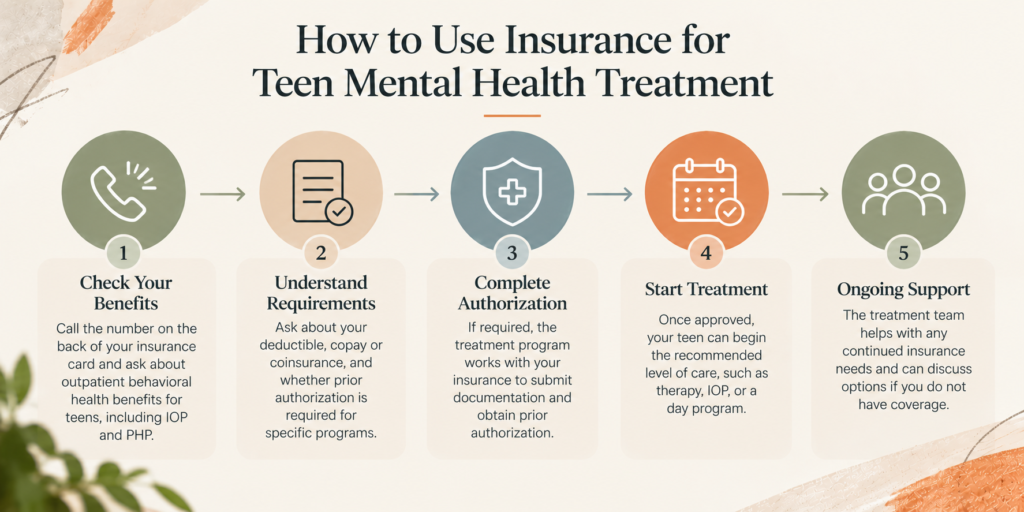
Ask the program for a cost estimate once your benefits have been verified. Any reputable program will provide one, and asking for it early is normal rather than awkward.
What questions should you ask your insurer?
Have your member ID ready and ask for these specifically.
- Does my plan cover outpatient behavioral health treatment for a dependent?
- Does it cover intensive outpatient and partial hospitalization programs? Ask about each by name.
- Is prior authorization required, and who submits it?
- What is my remaining deductible for the year?
- What is my coinsurance or copay for this level of care?
- Is [program name] in network?
- Is a referral required before treatment begins?
- How many sessions or days are covered, and how is continued care reviewed?
Ask for a reference number for the call and write down who you spoke with. If an answer later turns out to be wrong, that reference is what gets it corrected.
What if you do not have insurance?
There are real options, and programs field this question constantly.
Ask any program directly about payment plans and sliding scale rates. Many offer both and will not mention it unless asked. Community mental health centers often charge based on income and serve families regardless of ability to pay.
School counselors are free and can provide short-term support, though usually not ongoing therapy. For a crisis, the 988 Suicide and Crisis Lifeline is free and available at any hour.
If cost is the barrier, say so plainly when you call a program. It is a common conversation and it is better had at the start than after treatment has begun.
If your teen is in immediate danger, call or text 988 to reach the Suicide and Crisis Lifeline, or call 911.
Does using insurance for mental health create problems later?
This worry comes up often and is largely unfounded, though it is worth understanding why.
Treatment records are protected health information. They do not appear on school records, and they are not visible to colleges or employers. Future health coverage cannot be denied based on a pre-existing condition.
What insurers do see is that a claim was filed, which is how claims work for any medical care. That is different from your teen’s session content, which stays with the clinician.
How does this work at EQ Health?
EQ Health works with most insurance providers, including Aetna, Cigna, Blue Cross, and Optum.
Assessments are free, which means a family can find out what level of care is recommended before making any financial commitment. If a program is recommended, EQ handles the insurance authorization as part of admission.
The programs run from the Burr Ridge office, serving Burr Ridge, Darien, Hinsdale, Downers Grove, Lemont, and the surrounding communities. EQ Health is accredited by The Joint Commission.
Frequently asked questions
Does insurance cover teen mental health treatment?
Most commercial plans cover it, including structured programs, when a clinician documents medical necessity. What you pay depends on your plan, your deductible, and whether prior authorization is approved.
What is prior authorization?
Your insurer’s approval before a program starts. The program usually submits it as part of admission. It generally involves a clinician documenting why this level of care is needed.
What happens if prior authorization is denied?
Denials can be appealed, and appeals are often successful. Ask the program to handle the appeal, since they have the clinical documentation. You can also ask your insurer for the specific reason in writing.
What does mental health parity mean for my costs?
Federal law requires plans that cover mental health to apply standards comparable to those used for medical care. In practice that means your plan cannot impose harsher limits on behavioral health than on a comparable medical service.
What if we have not met our deductible?
You pay the negotiated rate until the deductible is met, then coinsurance applies. Ask the program for an estimate of what that looks like before starting, so the first bill is not a surprise.
Are there options if we do not have insurance?
Several, and they are worth asking about directly. Many programs offer payment plans or a sliding scale. Community mental health centers often charge based on income. School counselors are free, and the 988 Lifeline is free in a crisis.
Is an assessment free anywhere?
Some programs offer them at no cost, including EQ Health. A free assessment is a way to find out what level of care is recommended before any financial commitment.
Will using insurance for mental health affect my teen later?
Treatment records are protected health information. They do not appear on school records or credit reports. Health insurance records are governed by privacy law, and future coverage cannot be denied based on a pre-existing condition.
Does my teen need a referral before insurance will pay?
Some plans require one and many do not. Ask your insurer directly, since this varies by plan type rather than by provider.
EQ Health offers free assessments and works with most insurance providers. Call 630-366-9966 to talk through coverage and what your teen needs.