
Family therapy for teens brings a teenager and their parents, and sometimes siblings, into sessions with a licensed therapist. The focus is on how family members communicate and respond to each other rather than on assigning fault. It is standard in adolescent treatment because teens live at home, and home is where most of the change has to hold.
Parents often arrive at family therapy braced for criticism. That is not what it is, and the sessions go better once that assumption is out of the way. Here is what actually happens and what to expect from it.
What is family therapy for teens?
Family therapy is sessions where a teen and their family meet together with a therapist. Sessions usually run about an hour, often every week or two, though the schedule depends on the setting.
The therapist works with the family as a unit rather than treating one person while the others watch. What gets examined is the space between people, meaning how a request lands, how conflict escalates, what nobody says out loud.
In structured treatment programs, family sessions are a scheduled part of the program rather than something arranged separately.
Why does the whole family attend when one teen is struggling?
Because a teen goes home after every session.
An hour a week with a therapist is a small part of a teenager’s life. The rest happens at home, at school, and with friends. If home stays exactly as it was, a lot of the progress made in individual sessions gets undone between appointments.
There is also information parents have that nobody else does. You see the mornings, the shift in mood after school, the pattern that has been building for months. That context changes what a therapist can do.
And some of what is happening is genuinely between people rather than inside one person. A conflict cycle that has settled in over a year is not something a teen can fix alone, however much work they do in their own sessions.
Is family therapy about blaming parents?
No, and it is worth saying plainly because most parents wonder.
A competent family therapist is not looking for a culprit. Families end up in difficult patterns for ordinary reasons, usually because everyone was trying to handle something hard with the tools they had. The therapist is interested in the pattern, not in who started it.
What family therapy does ask of parents is a willingness to look at your own part in a cycle, which is uncomfortable. That is different from blame, and most parents find the sessions considerably less confronting than they expected.
What happens in a family therapy session?
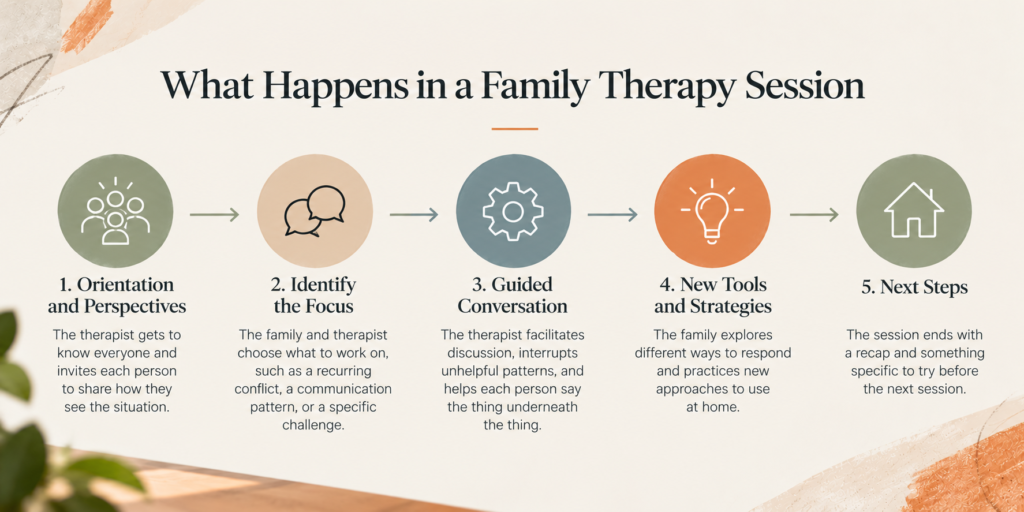
The first session is mostly orientation. The therapist asks each person how they see the situation, which frequently produces the first useful moment, since family members rarely hear each other lay it out uninterrupted.
Later sessions tend to focus on something specific. A recurring argument, a rule that is not working, a piece of news nobody has managed to discuss. The therapist slows the conversation down, interrupts the parts that always go wrong, and gets people to say the thing underneath the thing.
There is usually something to try at home. A different way to open a difficult conversation, a change in how a rule gets enforced, or simply an agreement about what happens next time an argument starts.
Who attends?
It depends on the session and on what is being worked on.
Often it is the teen and one or both parents. Siblings join when the sibling relationship is part of the picture. Therapists also meet with parents without the teen at times, and with the teen alone.
Separated or divorced parents can both take part, and it can also work with one household participating. Therapists arrange this regularly and can hold separate sessions where that is easier.
What if my teen refuses to talk in front of us?
Expect this early on, and do not read it as failure.
Teens are often more guarded with parents in the room than they are one-on-one. A good part of the early work is making the room safe enough for a teen to say something honest, and that can take several sessions.
Therapists have a range of ways to work around silence, including talking with the teen alone and bringing a message back with permission. What matters is that your teen keeps attending while that trust builds.
What can family therapy help with?
The situations that brought most families in. Constant conflict. A teen who has withdrawn and stopped talking. Disagreement between parents about how to handle things. Rules that have stopped working as a teen has got older.
It is also used alongside treatment for anxiety, depression, and school avoidance, where how a family responds to symptoms has a direct effect on how the symptoms behave.
If your teen is in immediate danger, call or text 988 to reach the Suicide and Crisis Lifeline, or call 911.
How is family therapy included in treatment programs?
In structured adolescent programs, family sessions are usually built into the program rather than arranged separately or billed on their own. Worth confirming before you enroll anywhere, because programs differ on this and it affects both the cost and how much the family is actually involved.
Being part of the program also means the family therapist and the rest of the treatment team are working from the same information, which is difficult to arrange when the pieces are separate.
Family therapy for teens in the western suburbs
EQ Health includes family sessions in both of its adolescent programs, run from its Burr Ridge office and serving Burr Ridge, Darien, Hinsdale, Downers Grove, Lemont, and the surrounding communities.
Family sessions are part of the program rather than an additional service billed separately. The intensive outpatient program runs 9:00 am to 12:00 pm, three to five days a week, with teens returning to school in the afternoon. The day program runs 9:00 am to 3:00 pm, five days a week, with academic support built into treatment hours.
Care follows the Emotional Growth Model, which builds self-awareness before coping skills. EQ Health is accredited by The Joint Commission and works with most insurance providers, including Aetna, Cigna, Blue Cross, and Optum. Assessments are free.
Frequently asked questions
Is family therapy about blaming parents?
No. A competent family therapist is not looking for someone at fault. The work is about patterns between people rather than blame, and parents are treated as the people best positioned to help.
Who has to attend family therapy?
It varies by session and by what is being worked on. Often it is the teen and one or both parents. Siblings sometimes join, and sometimes the therapist meets with parents alone.
Do both parents need to come if we are separated?
Not necessarily, and it can still work with one household participating. Therapists are used to arranging this, including separate sessions when that is easier.
What if my teen refuses to speak in front of us?
Common in early sessions, and the therapist plans for it. Much of the early work involves making the room safe enough for a teen to say something honest, which often takes a few sessions.
Is family therapy the same as parent coaching?
No, though they overlap. Parent coaching works with parents alone on strategies. Family therapy works with the family together on how members interact.
How long does family therapy take?
Fewer sessions than people expect, in many cases. Some families work through a specific pattern in a handful of sessions. Others continue longer, particularly when several things are happening at once.
Does insurance cover family therapy?
Most commercial plans cover it as part of outpatient behavioral health treatment. In structured programs family sessions are usually included in the program rather than billed separately. Ask before you start.
Will the therapist tell us what our teen says individually?
Not the details. Therapists working with adolescents keep individual disclosures private, with exceptions for safety. They will tell you what you need to know to help.
What if the family therapy sessions turn into arguments?
That happens, and a skilled therapist uses it. A conflict surfacing in the room is more workable than the same conflict happening at home with nobody to interrupt it.
EQ Health includes family therapy in its adolescent programs in Burr Ridge, IL. Call 630-366-9966 or schedule a free assessment to talk through what would help your family.