
You’ve been going to therapy. You show up, you talk, you try the things your therapist suggests. And you still feel stuck, or worse.
That doesn’t mean therapy can’t help you, and it doesn’t mean you’re doing it wrong. Sometimes the approach needs to change. Sometimes one hour a week just isn’t enough for what you’re dealing with right now. Here’s how to tell the difference.
Why Therapy Sometimes Stops Working
Progress in therapy is rarely a straight line. But if you’ve been stuck for a while, one of these is often part of the reason:
- The fit isn’t right. The connection with your therapist matters a lot. If you don’t feel understood, it’s hard to make progress.
- The approach isn’t matched to the problem. Some conditions respond better to structured, skills-based approaches than to open-ended talk therapy.
- The dose is too low. One hour a week leaves 167 hours to get through on your own. When symptoms are severe, that gap can be too big.
- Something biological needs attention. Depression, anxiety, and bipolar disorder sometimes need medication alongside therapy.
- Life got harder. A loss, a breakup, a job change, or a health problem can push symptoms past what weekly sessions can hold.
What to Try First
Before deciding therapy isn’t working, it’s worth a direct conversation with your therapist. Good therapists want this feedback.
- Say it plainly. “I don’t feel like I’m making progress” is a useful thing to bring to a session.
- Set clear goals. Agree on what better would look like, and check in on it regularly.
- Ask about a different approach. Ask whether a more structured or skills-based method might fit better.
- Ask about a medication evaluation. A psychiatric provider can tell you whether medication could help.
- Consider a new therapist. Switching isn’t failure. Fit is one of the strongest predictors of progress.
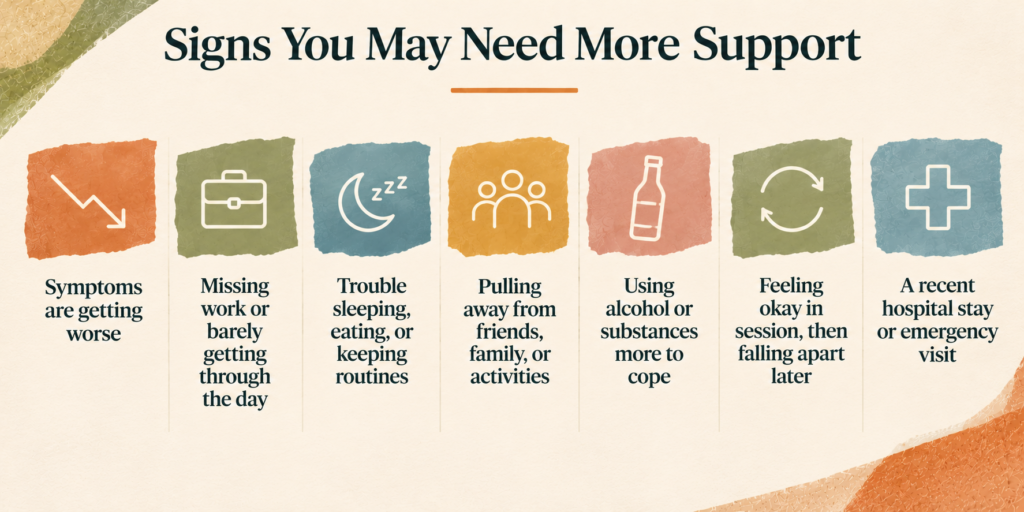
Signs You Need More Than Weekly Therapy
Sometimes the problem isn’t the therapist or the approach. It’s that your symptoms need more support than one session a week can give. These are signs it may be time for a higher level of care:
- Your symptoms are getting worse, not staying the same
- You’re missing work, or barely getting through the day
- You’re having trouble sleeping, eating, or keeping up with basic routines
- You’re pulling away from friends, family, or things you used to enjoy
- You’re drinking or using substances more to cope
- You feel fine in session, then fall apart a day or two later
- You’ve had a recent hospital stay or emergency visit and need more structure
If several of these sound familiar, it doesn’t mean something is wrong with you. It means you need more support right now, and that’s treatable.
What More Support Looks Like
There’s a lot of room between weekly therapy and a hospital stay. For adults, the options usually look like this:
Medication Management
A psychiatric provider evaluates whether medication could help and adjusts it over time. Many people do this alongside their current therapy.
Intensive Outpatient Program (IOP)
About three hours a day, three to five days a week, mostly in small groups. At EQ Health, the adult IOP meets 4:00 to 7:00 pm, so many people keep working. A virtual IOP is also available for adults anywhere in Illinois.
Partial Hospitalization Program (PHP)
A full-day program, about six hours a day, five days a week. You go home every night. At EQ Health, adult PHP runs 9:00 am to 3:00 pm on weekdays. It’s for when symptoms are making daily life very hard.
Inpatient Care
- 4-hour care in a hospital, for when you need to be somewhere safe around the clock. Many people step down to PHP afterward.
For a side-by-side comparison of weekly therapy, IOP, and PHP, see our guide to evening IOP for adults.
Do You Have to Stop Seeing Your Therapist?
Not necessarily. Some people keep their outpatient therapist while they’re in a program, and some pause and return afterward. It’s worth talking about with both your therapist and the program team. Good programs coordinate with your existing providers and plan your return to weekly therapy before you finish.
If you are in crisis or thinking about ending your life, call or text 988 to reach the Suicide and Crisis Lifeline, or go to your nearest emergency room.
Getting More Support at EQ Health in Burr Ridge
EQ Health is a Joint Commission accredited mental health center in Burr Ridge, Illinois. We offer individual therapy, medication management, an evening IOP, a virtual IOP, and an adult PHP under one roof. That means you can move up or down a level of care without starting over with a new team.
Not sure which level fits? That’s what the assessment is for. We’ll listen, recommend the right level of care, and help with insurance.
Schedule a free assessment or call 630-366-9966.
Frequently Asked Questions
How do I know if therapy is working?
You should notice some change over time, such as fewer or milder symptoms, better coping, or more insight. If you’ve seen no change in several months, or things are getting worse, talk with your therapist.
Is it normal to feel worse before you feel better in therapy?
Sometimes. Working through hard things can be uncomfortable at first. But if you’re steadily getting worse, struggling to function, or feeling unsafe, that’s a sign to get more support.
What’s the next step after weekly therapy?
Common next steps include medication management, an intensive outpatient program (IOP), or a partial hospitalization program (PHP), depending on how much your symptoms are affecting daily life.
Can I do IOP while still seeing my therapist?
Often, yes. Talk with both your therapist and the program team so your care is coordinated.
Do I need a referral for a higher level of care?
At EQ Health, you can request an assessment directly. The team will recommend the right level of care.