
What is an IOP? An IOP, or intensive outpatient program, is structured treatment that runs several hours a day, several days a week, while you continue living at home. Most programs combine group therapy, individual sessions, and medication management. IOP sits between weekly therapy and a partial hospitalization program.
If a therapist, doctor, or hospital just used the term with you, it probably arrived without much explanation. Here is what the program actually involves, who it is built for, and how it compares to the other options.
What does IOP stand for?
IOP stands for intensive outpatient program.
Outpatient means you go home at the end of each day. Intensive means the schedule is far heavier than a weekly therapy appointment. Put together, it describes treatment that takes up a real part of your week without requiring you to live at a facility.
One note on the acronym. In eye care, IOP means intraocular pressure. This article covers the behavioral health meaning.
What happens in an IOP?
Group therapy carries most of the schedule. Groups run with a licensed clinician and a consistent set of participants, which matters more than people expect. Familiarity is what makes the sessions useful after the first week.
Individual sessions run alongside the groups. These are one-on-one with a therapist and focus on your specific situation rather than the group topic.
Family sessions are included in many programs, particularly adolescent ones. Medication management is usually available through a psychiatrist or nurse practitioner if it applies to you.
Content varies by program and track. Common material includes skills for managing anxiety and depression, emotion regulation, relapse prevention for substance use, and processing whatever brought you in.
Who is an IOP for?
IOP fits people whose symptoms need more attention than a weekly session provides, but who do not need hospital care.
A few common situations. Weekly therapy has plateaued and symptoms are not improving. Depression or anxiety has started interfering with work, school, or relationships. Someone is stepping down from a hospital stay or a partial hospitalization program and needs continued structure. Substance use has reached a point where outpatient counseling alone is not holding.
Programs generally run separate adult and adolescent tracks, since a 15-year-old and a 45-year-old need different rooms and different material.
How is IOP different from PHP and inpatient care?
The difference is time and where you sleep.
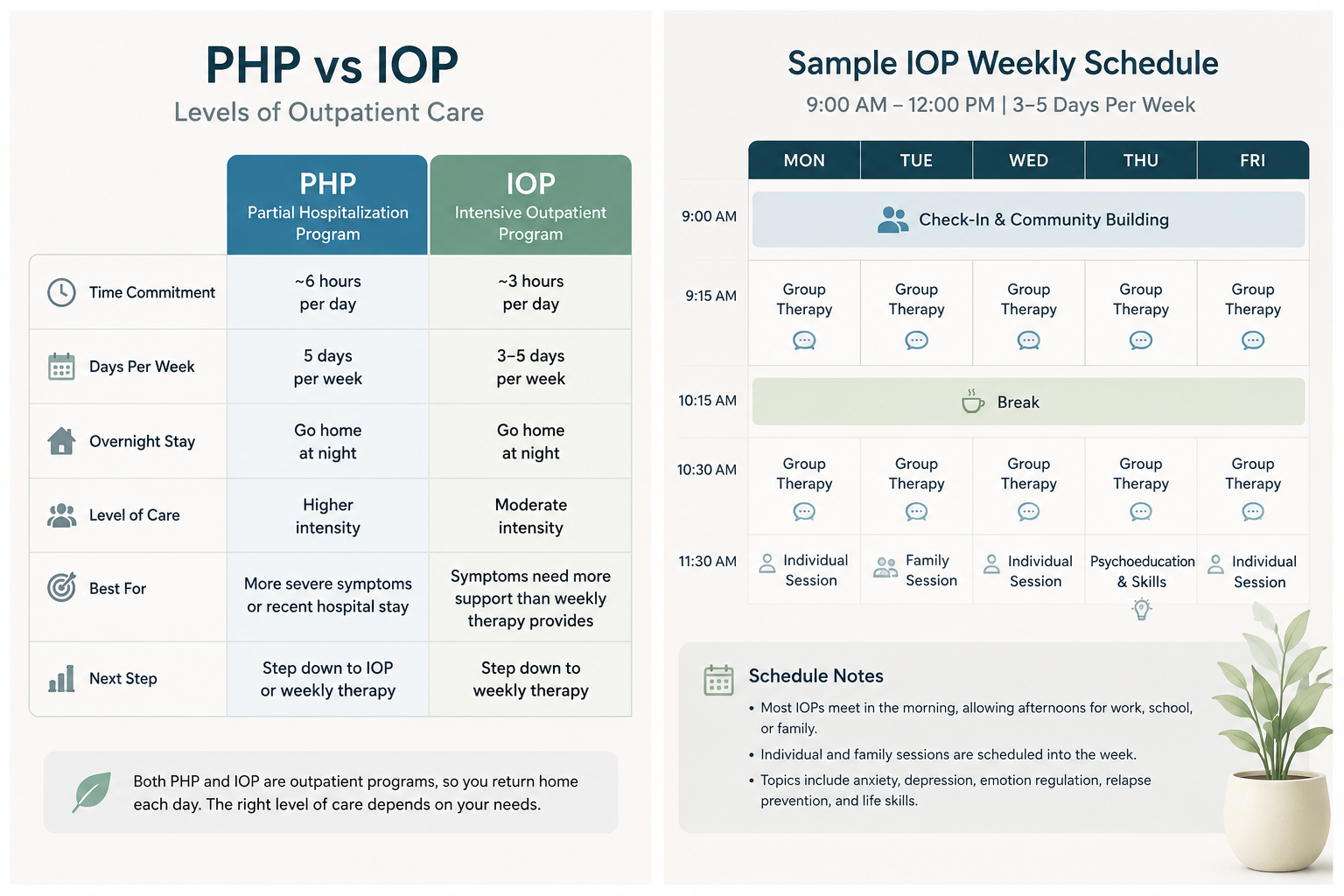
IOP runs about three hours a day, three to five days a week. A partial hospitalization program, or PHP, runs roughly six hours a day, five days a week. Both are outpatient, so you go home every night. Residential and inpatient care both involve staying overnight, with inpatient reserved for acute safety situations.
People often move down that ladder over time. Someone might start in PHP, step to IOP, and finish in weekly therapy. That sequence is normal and it is usually the plan from the beginning.
Difference between PHP and IOP
How long does an IOP last?
Program length depends on the person and the program. Many run in a range of several weeks rather than several months, with progress reviewed regularly along the way.
Two things drive the timeline. How severe symptoms were at intake, and how someone responds once treatment starts. Neither is predictable at the first appointment, which is why programs review rather than assign a fixed end date.
Our curriculum is 6 weeks but it is based on symptoms.
Can you work or go to school during an IOP?
Usually, and that is a large part of why IOP exists.
Schedules are built around the rest of life. At EQ Health, IOP runs 9:00 am to 12:00 pm, three to five days a week. Adolescents head to school for the afternoon. Adults arrange work around the morning block, and many use a reduced or shifted schedule during treatment.
If work is the obstacle, ask about protections available through the Family and Medical Leave Act and about what documentation your employer needs. Programs handle these requests regularly.
For students, ask the program who communicates with the school and what accommodations are available during treatment.
What does a day in an IOP look like?
Most IOP days run in a single block rather than spread across the day. At EQ Health that block is 9:00 am to 12:00 pm.
A typical morning opens with a check-in where everyone reports how the last day or two went. Then groups run back to back, usually two, with a short break between. Individual and family sessions are scheduled into the week rather than happening every day.
The room is less clinical than most people picture. Chairs in a circle, a clinician leading, conversation and exercises rather than lectures. People who dread the first day usually report the format was the least difficult part of it.
How is a mental health IOP different from a substance use IOP?
The structure is similar. The content is not.
A mental health track focuses on symptoms and the skills that manage them, covering anxiety, depression, emotion regulation, and the thinking patterns underneath. A substance use track adds relapse prevention, trigger identification, and recovery planning, and often connects with community support outside program hours.
Plenty of people need both, since substance use and mental health conditions frequently occur together. Programs that treat them at the same time rather than in sequence describe that as dual diagnosis or co-occurring care.
EQ Health runs mental health and substance use tracks within its adult IOP. The adolescent IOP focuses on mental health.
How do you prepare for the first day?
Less preparation is needed than most people assume, but a few things help.
Bring your insurance card, a photo ID, and a list of any medications with doses. If you have been in treatment before, the name and contact for your previous therapist or prescriber saves the team time.
Sort out logistics in advance. Parking, the entrance to use, how long the first day runs, and what to do about work or school that morning. Small unknowns cause more first-day anxiety than the treatment itself.
Expect the first day to involve more paperwork and orientation than group work. That is normal, and the schedule settles into its real shape by day two or three.
What does an IOP cost?
Most commercial insurance plans cover IOP when a clinician documents medical necessity. Federal parity law requires plans that cover mental health to apply standards comparable to those they use for medical care.
What you actually pay depends on your plan, your deductible, and whether prior authorization is approved. Call the number on the back of your insurance card and ask about outpatient behavioral health benefits. Ask about IOP by name, since plans sometimes treat it differently from standard outpatient therapy.
EQ Health works with most insurance providers, including Aetna, Cigna, Blue Cross Blue Shield, and Optum/United Healthcare.
What are your most popular IOP programs?
EQ Health offers an evening adult IOP program for those 18 and up. It runs Monday-Thursday from 5-8pm and Saturday from 9-12pm. This is a fantastic option for college students or anyone with a strict daytime job or schedule that’s seeking structured support.
How do you know if you need an IOP?
An assessment answers this. A clinician evaluates symptoms, history, safety, and how much daily functioning has changed, then recommends a level of care.
Some signs that the conversation is worth having. Symptoms have not improved despite consistent weekly therapy. Work or school attendance is slipping. Sleep, appetite, or relationships have changed noticeably. You have been in treatment before and recognize the pattern starting again.
EQ Health offers a free assessment, which is generally the fastest way to get a straight answer about what level of care fits.
If your teen is in immediate danger, call or text 988 to reach the Suicide and Crisis Lifeline, or call 911.
What does IOP look like at EQ Health?
EQ Health runs intensive outpatient programs for both adults and adolescents out of its Burr Ridge office.
The adult IOP runs 9:00 am to 12:00 pm, three to five days a week, with mental health, substance use, and virtual tracks. The adolescent IOP runs the same hours with a mental health focus, and teens return to school in the afternoon.
Both include individual and family sessions, with medication management available through a nurse practitioner. Care follows the Emotional Growth Model, which builds self-awareness before coping skills so the work holds up after the program ends.
EQ Health is accredited by The Joint Commission.
Frequently Asked Questions
What does IOP stand for?
IOP stands for intensive outpatient program. It describes structured treatment that runs several hours a day, several days a week, while you continue living at home.
Is IOP the same as rehab?
Not exactly. Rehab usually refers to residential treatment where you live on site. IOP is outpatient, so you go home each day. Some IOPs do treat substance use, which is where the terms get mixed up.
Do you sleep at the facility during an IOP?
No. IOP is an outpatient program and you go home every day. Programs where you stay overnight are residential or inpatient care.
How many days a week is an IOP?
Most run three to five days a week. The exact schedule depends on the program and on what a clinician recommends for you.
Can you fail an IOP?
Programs are not pass or fail. If someone is not making progress, the treatment plan changes or the level of care is adjusted. Missing sessions is a reason to talk with the team, not a reason to quit.
Will my employer find out?
Your treatment records are protected health information. If you request leave or an accommodation, your employer receives only what is needed to support that request, not your clinical details.
Does IOP include medication?
Medication management is available at many programs, including EQ Health, through a psychiatrist or nurse practitioner. It is part of the treatment plan when it applies rather than a requirement for everyone.
What happens after an IOP ends?
Most people step down to a lower level of care. That usually means weekly individual therapy, sometimes with continued medication management. Discharge planning sets it up before the last day.
Do I need a referral for an IOP?
No referral is required to request an assessment. Your insurance plan may require prior authorization before the program begins, which the program handles as part of admission.
EQ Health runs adult and adolescent intensive outpatient programs in Burr Ridge, IL. Call 630-366-9966 or schedule a free assessment to find out which level of care fits.