
You know the feeling. Something small happens, and your reaction is suddenly much bigger than the moment. Then comes the crash, the guilt, or the apology. Afterward you wonder why you can’t just stay calm like everyone else seems to.
If that pattern sounds familiar, you may be dealing with emotional dysregulation. It’s common, it’s not a character flaw, and it responds well to treatment. This guide explains what it looks like in adults, where it comes from, and how people learn to manage it.
What Is Emotional Dysregulation?
Emotional dysregulation means having a hard time managing the intensity and length of your emotions. Feelings come on fast, hit hard, and take a long time to settle. When that happens, it’s hard to think clearly or respond the way you want to.
Everyone has moments like this. Emotional dysregulation is when they happen often enough to strain your relationships, your work, or your sense of who you are.
It isn’t a diagnosis on its own. It’s a pattern that shows up across many conditions, and it’s one of the most common reasons adults look for more support than weekly therapy.
Signs of Emotional Dysregulation in Adults
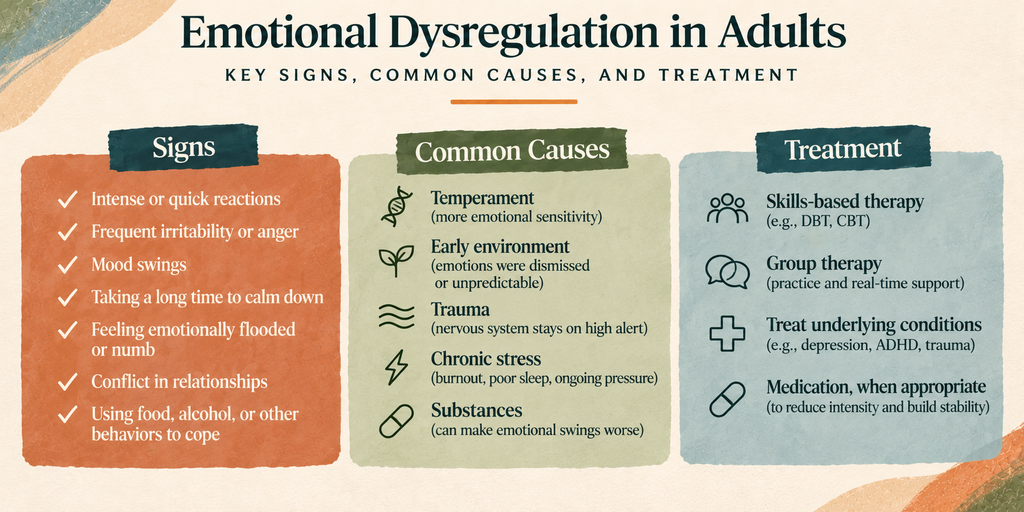
It can look different from person to person. Common signs include:
- Reactions that feel out of proportion to what happened
- Anger or irritability that flares up quickly
- Mood swings within the same day
- Taking a long time to calm down after you’re upset
- Feeling emotionally flooded, numb, or shut down
- Saying or doing things in the moment that you regret later
- Conflict in close relationships, or a fear of being rejected or left
- Using food, alcohol, spending, or other behaviors to escape a feeling
- Strong shame or self-criticism after an emotional reaction
Many adults have lived with these patterns so long they assume it’s just their personality. It often isn’t. It’s a set of skills that never got the chance to develop, and skills can be learned.
What Causes Emotional Dysregulation?
There’s rarely a single cause. Usually it’s a mix of:
- Some people are born more emotionally sensitive and reactive.
- Early environment. Growing up where emotions were dismissed, punished, or unpredictable can leave you without a model for handling them.
- Past trauma can keep your nervous system on high alert, so reactions fire faster and stronger.
- Chronic stress. Long periods of stress, poor sleep, or burnout lower everyone’s ability to regulate.
- Alcohol and other substances can make emotional swings worse, even when they feel like they help in the moment.
Conditions Linked to Emotional Dysregulation
Emotional dysregulation often shows up alongside:
- Depression and anxiety
- ADHD
- Trauma and PTSD
- Bipolar disorder
- Borderline personality disorder
- Eating disorders and substance use
That’s part of why a full evaluation matters. Treating what’s underneath the pattern is often what makes the change last.
How Emotional Dysregulation Is Treated
The good news is that emotional regulation is learnable. Treatment usually combines a few things:
- Skills-based therapy. Structured approaches teach you to notice emotions earlier, tolerate distress without making things worse, and respond on purpose instead of on impulse. Dialectical behavior therapy (DBT) and cognitive behavioral therapy (CBT) are two well-studied examples.
- Group therapy. Practicing skills with other adults who get it, and getting real-time feedback, speeds up learning in a way solo sessions often can’t.
- Treating underlying conditions. When depression, ADHD, trauma, or another condition is driving the pattern, addressing it directly helps.
- Medication, when appropriate. Medication doesn’t teach regulation skills, but it can lower the intensity enough for those skills to take hold.
How Much Support Do You Need?
For some adults, weekly therapy is enough. If emotional reactions are affecting your job, your relationships, or your safety, a more structured program can help you build skills faster. An intensive outpatient program (IOP) gives you several hours of skills-focused group work each week while you keep living your life.
Emotional Intelligence: The Other Side of Regulation
Regulation isn’t about shutting feelings down. It’s about understanding them well enough to choose what you do next. That’s emotional intelligence: recognizing what you feel, knowing why, and using that information instead of being run by it.
EQ Health is built around this idea. Our Emotional Growth Model is the foundation of care, and our approach is grounded in Six Seconds emotional intelligence training. Instead of only managing symptoms, treatment focuses on building self-awareness and emotional intelligence, which are the roots of lasting change.
In practice, adult groups at EQ Health work on:
- Building resilience and coping strategies
- Managing conflict and building healthier relationships
- Self-validation and self-esteem
- Clarifying core values and setting goals
Things You Can Start Practicing Now
These won’t replace treatment, but they can help in the moment:
- Name it. Putting a word to a feeling (“I’m frustrated,” “I feel rejected”) can take some of the edge off it.
- Pause before you respond. Even a few slow breaths or stepping away for a minute gives the thinking part of your brain time to catch up.
- Notice your patterns. Jot down what set off a strong reaction and what you felt in your body. Patterns show up quickly.
- Protect the basics. Sleep, food, and movement have a real effect on how reactive you feel.
- Go easy on yourself after. Shame tends to fuel the next reaction. Repair, then move on.
If you are in crisis or thinking about ending your life, call or text 988 to reach the Suicide and Crisis Lifeline, or go to your nearest emergency room.
Emotional Dysregulation Treatment at EQ Health in Burr Ridge
EQ Health is a Joint Commission accredited mental health center in Burr Ridge, Illinois, serving adults across the western and southwestern suburbs. Our levels of care for adults include:
- Evening IOP, 4:00 to 7:00 pm, three to five days a week, so many people can keep working
- Partial hospitalization (PHP), 9:00 am to 3:00 pm on weekdays, for when you need more support
- Individual therapy and medication management
Every program starts with a full evaluation, so treatment addresses what’s driving the pattern, not just the reactions.
Schedule a free assessment or call 630-366-9966.
Frequently Asked Questions
Is emotional dysregulation a mental illness?
No. It isn’t a diagnosis on its own. It’s a pattern of difficulty managing emotions that often shows up alongside conditions like depression, anxiety, ADHD, trauma, or borderline personality disorder.
Can adults learn to regulate their emotions?
Yes. Emotional regulation is a set of skills, and adults can learn them at any age with the right treatment and practice.
What is the best therapy for emotional dysregulation?
Skills-based approaches such as dialectical behavior therapy (DBT) and cognitive behavioral therapy (CBT) are well-studied. Group programs that focus on regulation and emotional intelligence skills can also help.
Is emotional dysregulation linked to ADHD?
Often, yes. Many adults with ADHD have trouble regulating emotions. Treating the ADHD can help, along with learning specific regulation skills.
When should I get more than weekly therapy?
If emotional reactions are hurting your work, relationships, or safety, or weekly therapy hasn’t helped enough, a structured program such as an IOP may be a better fit.