
Sometimes getting through the workday is the hardest part. If depression, anxiety, or another mental health condition is making it hard to function, taking time off for treatment can be the fastest way back to feeling like yourself.
Many adults don’t realize how many options they have. This guide covers the main types of leave available in Illinois, how to ask for it, and how to plan your return. It’s general information, not legal advice. Your HR department or an employment attorney can tell you exactly what applies to you.
Can You Take Medical Leave for Mental Health?
Yes. Under the federal Family and Medical Leave Act (FMLA), a mental health condition can qualify as a “serious health condition” the same way a physical one can. That includes conditions that need inpatient care, and conditions that need continuing treatment from a health care provider, such as depression or anxiety that keeps you from working.
Starting a structured program like partial hospitalization is one of the most common reasons adults take mental health leave. A day program runs during working hours, so you often need time away to attend.
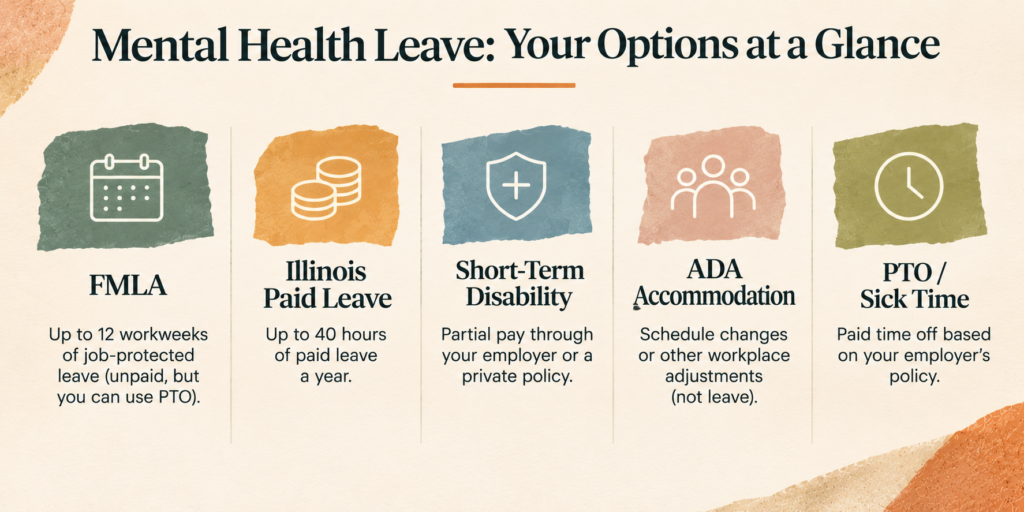
Your Leave Options
Most people combine more than one of these. Here’s how they compare.
| Option | Paid? | Job protected? | How much time |
|---|---|---|---|
| FMLA | No, but you can use paid leave at the same time | Yes | Up to 12 workweeks a year |
| Illinois paid leave | Yes | Yes, employers can’t retaliate | Up to 40 hours a year |
| Short-term disability | Partial pay, through your employer or a private policy | Not on its own (often paired with FMLA) | Depends on your plan |
| ADA accommodation | Not leave itself | Yes | Schedule changes or other adjustments |
| PTO / sick time | Yes | Depends on employer policy | What you’ve accrued |
FMLA
FMLA gives eligible employees up to 12 workweeks of job-protected leave a year. It’s unpaid, but you can usually run paid time off alongside it. You’re eligible if:
- You’ve worked for your employer for at least 12 months
- You’ve worked at least 1,250 hours in the past 12 months
- Your employer has at least 50 employees within 75 miles of your worksite
FMLA doesn’t have to be taken all at once. If you need to leave work early a few days a week for an evening program, that can also qualify as leave on a reduced schedule when it’s medically necessary.
Your employer can ask for a certification from your health care provider. That form confirms you need leave. It doesn’t require you to share your diagnosis.
Illinois Paid Leave
Under the Illinois Paid Leave for All Workers Act, most employees in the state earn up to 40 hours of paid leave a year. You can use it for any reason, and your employer can’t require documentation. It won’t cover a full program on its own, but it can cover your first assessment, the first days of treatment, or the gap before short-term disability starts. If you work in Chicago or Cook County, local paid leave rules may apply instead.
Short-Term Disability
Illinois doesn’t have a state-run short-term disability program, so coverage usually comes through your employer or a private policy. Many plans cover mental health conditions, including depression and anxiety, and replace part of your income while you’re unable to work. Most have a waiting period of several days before benefits start. Check your plan documents or ask HR.
ADA Accommodations
If your employer has 15 or more employees, the Americans with Disabilities Act may require reasonable accommodations for a mental health condition. For treatment, that might mean a modified schedule so you can leave in time for an evening program.
How to Take a Mental Health Leave From Work
- Get an assessment first. A clinician can recommend the right level of care. That tells you whether you need full days off for a day program, or just a schedule change for evening treatment.
- Contact HR, not just your manager. HR handles leave requests and keeps medical information confidential. You can tell your manager you’re taking medical leave without saying why.
- Ask what’s available. Ask specifically about FMLA, short-term disability, and paid leave balances. Ask for the forms and deadlines.
- Get the paperwork to your provider. Your treatment team completes the medical certification. Give them the forms early, because insurers and employers have deadlines.
- Plan your return before you leave, if you can. A return date, even an estimated one, makes the conversation easier for everyone.
Which Treatment Usually Needs Leave?
It depends on the level of care. At EQ Health:
- Partial hospitalization (PHP) runs 9:00 am to 3:00 pm on weekdays. Most people take leave while they’re in PHP.
- Evening IOP runs 4:00 to 7:00 pm, three to five days a week. Many adults keep working, sometimes with a reduced schedule on program days.
- Virtual IOP is available for adults anywhere in Illinois, which cuts out the commute.
A common path is a short leave for PHP, then a return to work while stepping down to evening IOP. That way you’re not going straight from intensive treatment to a full workload with no support.
What to Tell Your Employer
Less than you might think. In most cases, you only need to say that you have a medical condition that requires treatment and time off. You don’t have to name your diagnosis to your manager or coworkers. A short message works:
“I need to take medical leave for a health condition, starting [date]. I’m working with HR on the paperwork and will keep you posted on my expected return.”
Returning to Work After Mental Health Leave
Going back is a big step, and planning it helps. A few things make it smoother:
- Step down, don’t stop. Moving from PHP to evening IOP gives you support during your first weeks back.
- Ask about a gradual return. Some employers allow reduced hours at first.
- Expect paperwork. Some employers require a note from your provider confirming you’re ready to return.
- Decide what you’ll say. Coworkers may ask where you’ve been. “I was dealing with a health issue and I’m doing better” is plenty.
If you are in crisis or thinking about ending your life, call or text 988 to reach the Suicide and Crisis Lifeline, or go to your nearest emergency room.
Getting Started at EQ Health in Burr Ridge
EQ Health is a Joint Commission accredited mental health center in Burr Ridge, Illinois, serving adults across the western and southwestern suburbs. We offer an adult partial hospitalization program, an evening IOP, a virtual IOP, and medication management, so you can move between levels of care as you get better.
We can provide the documentation your employer or insurer asks for, and help you plan treatment around your return to work.
Schedule a free assessment or call 630-366-9966 to talk through your options.
Frequently Asked Questions
Can I take FMLA for depression or anxiety?
Yes, if you’re eligible and the condition requires inpatient care or continuing treatment from a health care provider. Depression and anxiety are common reasons for FMLA leave.
Do I have to tell my employer my diagnosis?
No. Your employer can ask for a medical certification confirming you need leave, but a diagnosis isn’t required. You don’t have to share details with your manager or coworkers.
Is mental health leave paid?
FMLA itself is unpaid, but you can often use paid time off, Illinois paid leave, or short-term disability benefits to replace some or all of your income.
How long can I take off for mental health?
Eligible employees can take up to 12 workweeks of FMLA leave a year. How long you actually need depends on your treatment plan.
Can I keep working while I get treatment?
Often, yes. An evening IOP is designed for that. A full-day program like PHP usually requires time off.