
You know weekly therapy is not cutting it anymore. But you also have a job, a mortgage, kids to pick up, or all three. Stepping away from your life for treatment can feel impossible.
An evening intensive outpatient program (IOP) is built for exactly that problem. It gives you several hours of structured treatment a week, scheduled after a typical workday, so you can get real help without putting everything else on hold.
This guide explains what an evening IOP is, what the schedule looks like, who it fits, and when you might need more support.
What Is an Evening IOP?
An intensive outpatient program is a level of mental health care that sits between weekly therapy and a full-day program. Instead of one hour a week, you attend about three hours a day, several days a week. You live at home and keep your normal routine around it.
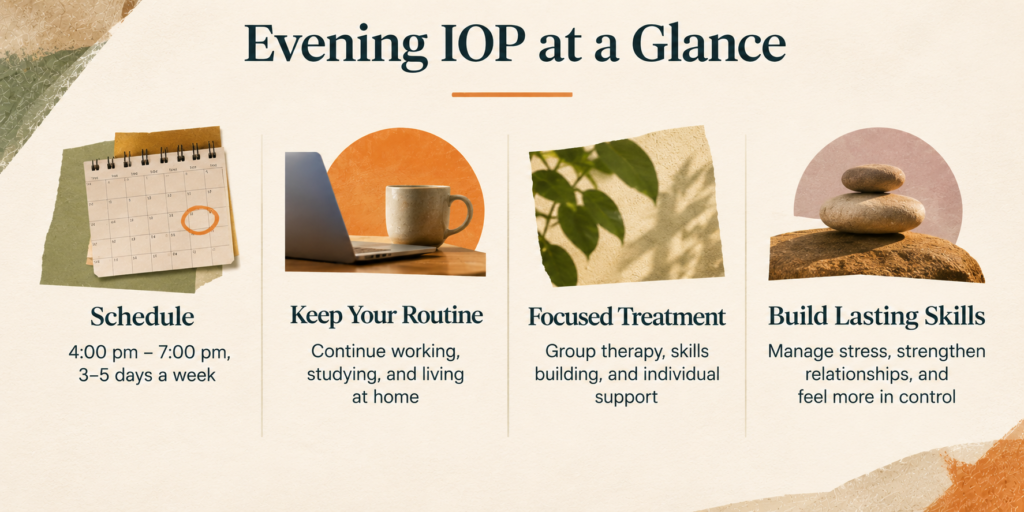
An evening IOP is the same level of care, scheduled in the late afternoon and evening. At EQ Health, the adult IOP meets from 4:00 pm to 7:00 pm, three to five days a week, for adults 18 and older.
That timing matters. Many adults who need more than weekly therapy are still working, studying, or caregiving. A daytime program asks them to choose between treatment and the rest of their life. An evening schedule removes that choice for a lot of people.
Can You Work While in an IOP?
Yes, and many people do. That is one of the main reasons IOP exists. The goal is to give you intensive support while you stay connected to your job, your family, and your routines, because those are the places where you will use what you learn.
Whether it works for you depends on a few things:
- Your hours. A 4:00 pm start works for many day-shift schedules. If you work until 5:00 or 6:00, talk with your employer about leaving early on program days, or ask about virtual options.
- Your commute. EQ Health is in Burr Ridge, close to I-55 and I-294. Adults working in the western and southwestern suburbs can often get there without much trouble.
- How you are functioning. If you are getting through the workday, even with difficulty, IOP is often a good fit. If you cannot get through the day at all, a higher level of care may be safer for now.
Some adults take a short leave from work for a more intensive day program first, then step down to evening IOP as they return to work. That is a common and very workable path.
How Evening IOP Compares to Other Options
Here is how the adult levels of care at EQ Health compare. Your clinician will recommend a level after an assessment.
| Weekly therapy | Evening IOP | Partial hospitalization (PHP) | |
|---|---|---|---|
| Schedule | About 1 hour a week | 4:00–7:00 pm, 3–5 days a week | 9:00 am–3:00 pm, weekdays |
| Hours per week | 1 | About 9–15 | About 30 |
| Can you keep working? | Yes | Usually yes | Usually needs time off |
| Best for | Stable symptoms, steady progress | Symptoms affecting daily life, but still functioning | Symptoms making daily life very hard |
What Happens During the Three Hours
Most of an evening IOP is small-group therapy led by licensed clinicians. Group work is the core of the program for a reason. You learn skills, practice them with other adults who understand what you are going through, and get honest feedback in a setting that feels safe.
At EQ Health, adult IOP groups focus on practical skills, including:
- Building resilience and coping with stress and triggers
- Managing emotions instead of being run by them
- Resolving conflict and forming healthier relationships
- Identifying core values and setting goals
- Improving self-esteem and self-validation
EQ Health’s approach centers on emotional intelligence: learning to recognize what you are feeling, understand why, and respond in ways that help rather than hurt. Before you start, the team completes a full evaluation and builds a treatment plan around your symptoms and goals. Medication management is available on site if it is part of your plan.
Who Is Evening IOP a Good Fit For?
EQ Health’s adult IOP treats a range of conditions, including:
- Major depression and other mood disorders
- Anxiety disorders
- Trauma and PTSD
- Obsessive-compulsive disorder (OCD)
- Bipolar disorder
- Eating disorders
- Substance use alongside a mental health condition
Evening IOP tends to be a good fit if you recognize yourself in a few of these:
- You have been in weekly therapy for a while and are not making enough progress
- Your symptoms are starting to affect your work, sleep, or relationships
- You recently finished a hospital stay or a day program and need continued structure
- You want more support but cannot step away from work entirely
When Evening IOP Is Not Enough
If you cannot get through the workday, are not sleeping or eating, or are struggling to stay safe, a full-day program is often the better starting point. EQ Health’s adult partial hospitalization program runs 9:00 am to 3:00 pm on weekdays and offers about three times the support of IOP. Many adults start in PHP and step down to evening IOP as they stabilize.
If you are in crisis or thinking about ending your life, call or text 988 to reach the Suicide and Crisis Lifeline, or go to your nearest emergency room.
Do You Have to Tell Your Employer?
Not necessarily. If your program hours do not overlap with your work hours, you may not need to tell anyone. If you need to leave early on program days, you can usually ask for a schedule change without sharing your diagnosis.
If you need more time away, such as for a day program, many employers offer medical leave or short-term disability. Your HR department can explain what your workplace offers, and your treatment team can provide documentation when needed. Laws and policies vary, so check with HR or an employment attorney for advice on your situation.
How Long Does an IOP Last?
It depends on your needs and progress. Many adults attend IOP for several weeks, and some start at five days a week and taper to three as they improve. Your treatment team will review your progress regularly and plan your step-down to weekly therapy before your last day, so you are not left without support.
Does Insurance Cover Evening IOP?
Most commercial insurance plans cover intensive outpatient programs when a clinician documents that it is medically necessary. Prior authorization is often required. Call the number on your insurance card and ask about “intensive outpatient program” coverage by name. EQ Health accepts most major insurance plans and can help verify your benefits as part of admission.
Evening IOP for Adults at EQ Health in Burr Ridge
EQ Health is a Joint Commission accredited mental health center at 16W285 83rd St in Burr Ridge, Illinois, serving adults from Darien, Downers Grove, Hinsdale, Lemont, Willowbrook, Westmont, and the surrounding western suburbs.
Our adult IOP meets 4:00 to 7:00 pm, three to five days a week. We also offer a virtual IOP for adults anywhere in Illinois and a full-day adult PHP for people who need more support. Whatever level fits right now, you can move between them as your needs change.
Ready to talk it through? Schedule a free assessment or call 630-366-9966.
Frequently Asked Questions
What time does evening IOP start?
At EQ Health, the adult IOP runs from 4:00 pm to 7:00 pm, three to five days a week. Other programs vary, so always ask about the exact schedule.
Can I go to IOP and keep my full-time job?
Many people do. An evening schedule is designed for that. If your workday ends after 4:00 pm, you may need to arrange an earlier finish on program days.
What is the difference between IOP and PHP?
The main difference is time. IOP is about three hours a day, three to five days a week. PHP is about six hours a day, five days a week, for people who need more support.
Is there a virtual option?
Yes. EQ Health offers a virtual IOP for adults living in Illinois, with the same three-hours-a-day structure.
Do I need a referral?
No referral is required to request an assessment at EQ Health. The team will recommend the right level of care and help with insurance authorization.
What happens after IOP?
Most adults step down to weekly individual therapy, sometimes with medication management. Your team plans that transition before you finish.