
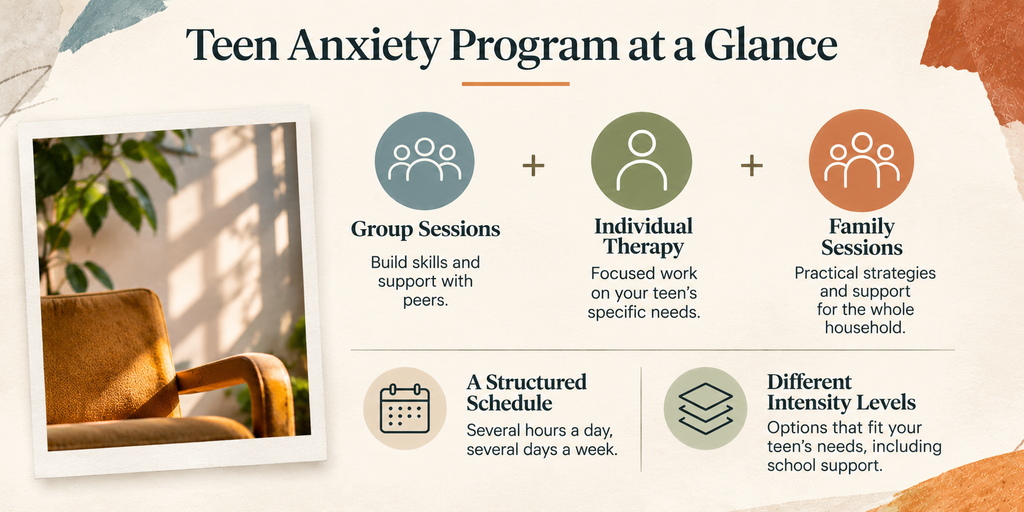
A teen anxiety program is structured treatment for adolescents whose anxiety needs more than a weekly therapy appointment. Programs run several hours a day, several days a week, while your teen continues living at home. Most combine group sessions, individual therapy, and family work.
Anxiety is the most common reason teens end up in structured mental health treatment. If weekly sessions have stopped moving things, a program is usually the next step discussed. Here is what one involves and how families decide whether it is warranted.
What is a teen anxiety program?
A program is treatment on a schedule rather than treatment by appointment. Instead of an hour a week, your teen attends for a block of hours on most days, with a consistent group and a consistent clinical team.
The core components are the same ones a good therapist uses, delivered more often. Group sessions where teens work on skills alongside peers dealing with the same thing. Individual sessions focused on your teen specifically. Family sessions, because anxiety usually involves the household whether anyone intended it to.
Programs come at different intensities. Some run a few hours in the morning, letting teens go to school afterward. Others fill the school day and build academic support into treatment hours.
Outpatient treatment for teens
How is a program different from weekly therapy?
Frequency, and what frequency makes possible.
Anxiety treatment works largely through practice. A teen learns to approach something they have been avoiding, in steps, and each step has to be repeated enough that the fear loses its grip. In weekly therapy the gap between sessions is seven days, which is a long time for avoidance to reassert itself.
In a program the next session is tomorrow. Something attempted on Tuesday gets reviewed Wednesday, adjusted, and tried again. That compression is the main reason programs move faster.
The group adds something else. Anxious teens tend to believe their reaction is uniquely excessive. Sitting with four peers describing the same thing takes that belief apart more efficiently than reassurance from an adult.
When does teen anxiety need more than weekly therapy?
Weekly therapy is the right starting point for most teens, and plenty never need anything else. A few situations change that.
When symptoms are not improving despite consistent attendance over a reasonable stretch. When avoidance has started to spread, so a teen is turning down more and more of ordinary life. When school attendance has become a problem. When sleep or eating have shifted noticeably. When the household has reorganized itself around managing a teen’s anxiety.
That last one is worth naming, because families rarely notice it happening. When parents are planning the week around what will or will not set off a panic response, the problem has outgrown an hour on Thursdays.
A clinical assessment is what actually answers this question. Guessing from the outside is difficult in both directions.
If your teen is in immediate danger, call or text 988 to reach the Suicide and Crisis Lifeline, or call 911.
What happens in a teen anxiety program?
Days follow a predictable structure, which matters more for anxious teens than it might seem. Knowing what is coming removes one source of worry before the clinical work even starts.
A typical day opens with a check-in, moves through group sessions, and includes individual time scheduled across the week. Group work covers practical skills, including how to recognize an anxiety response early, what to do when it escalates, and how to approach an avoided situation without waiting to feel ready.
There is usually something to practice outside the program. The point is not to feel calm in the room, which is relatively easy. The point is to handle the hallway, the cafeteria, or the conversation your teen has been dreading.
What kinds of anxiety do programs treat?
Programs generally work with the range rather than specializing in one thing.
That includes generalized worry that attaches to everything, social anxiety around peers and performance, panic that arrives without obvious warning, and anxiety tied to a specific situation like school or driving. Many teens have more than one going at once, and it is common for anxiety and low mood to arrive together.
Which of these a teen is dealing with is a clinical determination, not something to sort out from a list online. An assessment is the place where it gets named.
What if the anxiety is mostly about school?
School is where a lot of teen anxiety concentrates, and sometimes attendance itself becomes the problem.
When a teen has started missing school because of anxiety, that pattern has its own treatment considerations and its own urgency, because avoidance tends to deepen the longer it runs.
Does a program mean my teen falls behind?
It depends on the level of care and on how the program handles academics.
A morning program leaves afternoons for school, so teens miss morning classes and keep the rest of the day. A full-day program covers school hours, which makes built-in academic support important rather than optional. Ask any program directly whether teens do coursework during treatment hours and who talks to the school.
Tell the school early either way. Most districts can excuse absences and adjust deadlines during treatment, and attendance staff handle these requests more often than parents expect.
How long does treatment take?
Programs usually run in weeks rather than months, with progress reviewed as they go. How long depends on how a teen responds rather than on a fixed schedule.
Most teens step down rather than stopping. A teen might finish a full-day program, move to a morning one, then continue with weekly therapy. The step-down is part of the plan from the start, because going from daily structure to nothing is a steep drop.
Teen anxiety treatment in the western suburbs
EQ Health runs two adolescent programs from its Burr Ridge office, serving Burr Ridge, Darien, Hinsdale, Downers Grove, Lemont, and the surrounding communities. Anxiety is among the most common reasons teens attend either one.
The intensive outpatient program runs 9:00 am to 12:00 pm, three to five days a week, with teens returning to school in the afternoon. The day program runs 9:00 am to 3:00 pm, five days a week, with academic support built into treatment hours. Both include individual and family sessions, and medication management is available through a nurse practitioner when it applies.
Care follows the Emotional Growth Model, which builds self-awareness before coping skills, so teens understand what their anxiety is doing rather than just collecting techniques. EQ Health is accredited by The Joint Commission and works with most insurance providers, including Aetna, Cigna, Blue Cross, and Optum. Assessments are free.
Frequently asked questions
What is a teen anxiety program?
A structured treatment program built around anxiety, running several hours a day rather than one hour a week. Teens attend during the day and go home at night. Most combine group sessions, individual therapy, and family work.
How is that different from seeing a therapist for anxiety?
Mostly frequency and format. A weekly therapist sees your teen once. A program provides daily sessions plus a group of peers working on the same thing, which speeds up the practice part considerably.
Does my teen need a diagnosis first?
No. An assessment comes first and sorts that out. Plenty of families start without knowing whether what they are seeing is anxiety, something else, or a combination.
Will my teen have to face the thing they are afraid of?
Gradually, and at a pace set with the clinician. Treatment for anxiety does involve approaching avoided situations in steps, because avoidance is what keeps anxiety going. Nobody is thrown in at the deep end.
What if the anxiety is mostly about school?
That is one of the most common patterns, and programs are built around it. Ask how the program handles school hours and who coordinates with the district.
Is medication part of anxiety treatment?
Sometimes, and it is a conversation with a prescriber rather than a requirement. Many teens improve with therapy alone. At EQ Health, medication management is available through a nurse practitioner when it applies.
How long does a teen anxiety program last?
Usually weeks rather than months, with progress reviewed along the way. Teens typically step down to a lighter level of care rather than stopping outright.
What if my teen is too anxious to attend a program?
Common, and worth raising with the program before the first day. Clinicians who work with anxious teens plan for this, often starting with a shorter day or a slower entry into group sessions.
Can my teen keep going to school during treatment?
Usually yes, depending on the level of care. A morning program means afternoons at school. A full day program covers the school day, so ask whether academic support is built into treatment hours.
EQ Health treats adolescent anxiety through outpatient programs in Burr Ridge, IL. Call 630-366-9966 or schedule a free assessment to talk through what would help your teen.