
Group therapy for teens is a session where a small number of teenagers meet with a licensed clinician to work through what they are dealing with together. Groups usually run weekly, or daily inside a structured program. Most teens are reluctant before the first session and far less so by the third.
If a clinician has recommended group therapy for your teen, your first reaction may have been doubt. Parents tend to assume their teen will hate it, say nothing, and get less out of it than individual sessions. Here is what actually happens, and why group often reaches teenagers when other things have not.
What is group therapy for teens?
A group is a set number of teens meeting with one or two licensed clinicians on a regular schedule. Members are usually grouped by age and by the kind of thing they are working on, so a group might be built around anxiety, depression, or managing difficult emotions.
Sessions are structured rather than open-ended. A clinician leads, introduces a topic or a skill, and manages the conversation so that it stays useful and safe.
In weekly outpatient care, group might be one session a week. In a structured program it runs most days and forms the core of the treatment.
Why does group therapy work for teenagers?
Because of who is in the room.
Adolescence is a period when peer opinion carries enormous weight, often more than a parent’s or a clinician’s. That works against you when a teen dismisses everything an adult says. In group it works in your favor. A teen who has tuned out their parents will frequently take the same point seriously when another 16-year-old makes it.
There is a second effect that is harder to produce any other way. Most struggling teens believe they are uniquely broken. Sitting in a room where four other people describe the same experience dismantles that belief faster than reassurance from an adult ever does.
Group also gives teens a place to practice. Saying a difficult thing out loud, disagreeing with someone respectfully, or accepting support are all things teens can rehearse in a room designed for it.
What happens in a teen group therapy session?
Most sessions follow a familiar shape, which is part of what makes them feel manageable.
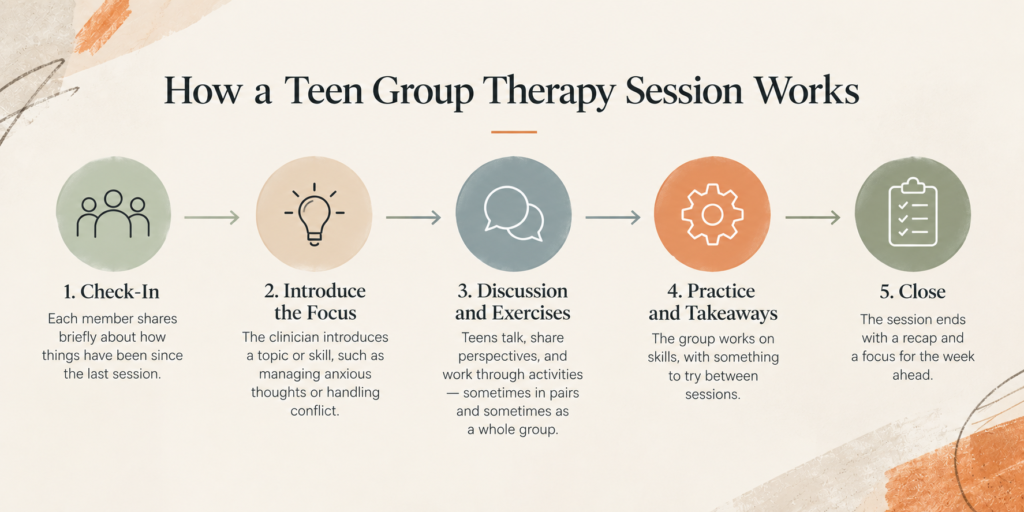
The session opens with a check-in where each member says briefly how the last day or week has gone. Then the clinician introduces the focus, which might be a skill like managing anxious thoughts or handling conflict. Discussion and exercises follow, sometimes in pairs, sometimes as a whole group. The session closes with something to take away.
Groups are not teens sitting in a circle confessing their problems, which is what most parents picture. A lot of sessions involve practical work, and some involve activity rather than sitting still.
What do teens actually talk about?
School pressure comes up constantly. So do friendships, conflict at home, social media, sleep, and the gap between how they feel and how they think they are supposed to feel.
Teens are usually more candid with each other than they are with adults, which is the point. Clinicians guide the conversation rather than driving it.
Is group therapy as good as individual therapy?
They do different jobs, and most treatment plans use both.
Individual sessions go deeper on your teen’s specific situation and history. Group provides the peer element and the practice, which individual sessions cannot replicate. In structured programs the two run alongside each other for that reason.
If you are choosing between them for weekly outpatient care, ask the clinician which fits your teen’s situation. For some teens the peer piece is the missing ingredient. For others, individual work has to come first.
What if my teen is anxious about being in a group?
Nearly every teen is, including the ones who end up finding it most useful.
Social anxiety is one of the more common reasons teens are referred to group in the first place. A group is a controlled setting to face exactly the thing that is difficult, with a clinician managing it. That is closer to treatment than to an obstacle.
Practically, no one is made to speak. Experienced clinicians let anxious teens listen for the first few sessions and draw them in gradually. Tell the program in advance if your teen is worried about this, so the clinician knows before day one.
Most teens dread the first session and feel differently by the third. If the dread is still there after that, say so rather than waiting it out.
What stays private in group therapy?
Groups set confidentiality rules at the start, and members agree to keep what is said in the room inside it. Clinicians hold the same confidentiality standards they do in individual sessions, with the same safety exceptions.
Parents receive progress updates in general terms rather than session content. That boundary is what lets teens speak freely, and removing it would remove most of the value.
Who is group therapy right for?
Most teens getting mental health treatment, at some point in the process.
It fits particularly well for teens dealing with anxiety, depression, social difficulty, or emotional regulation. It is also useful for teens who have become isolated, since the group itself starts rebuilding the habit of being around people.
It fits less well for a teen in acute crisis, who needs stabilisation first, and occasionally for a teen whose situation is far outside what the rest of the group is dealing with.
If your teen is in immediate danger, call or text 988 to reach the Suicide and Crisis Lifeline, or call 911.
How is group therapy used in structured programs?
In an intensive outpatient or day program, group is the spine of the schedule rather than one appointment among several.
A teen in a day program might be in group for several hours a day, with individual and family sessions scheduled around it. The daily repetition is a large part of why these programs move faster than weekly sessions, since skills get practiced the next morning rather than seven days later.
Group therapy for teens in the western suburbs
EQ Health runs adolescent group therapy as part of both of its structured programs, from its Burr Ridge office, serving Burr Ridge, Darien, Hinsdale, Downers Grove, Lemont, and the surrounding communities.
The intensive outpatient program runs 9:00 am to 12:00 pm, three to five days a week, with teens returning to school in the afternoon. The day program runs 9:00 am to 3:00 pm, five days a week, with academic support built into treatment hours. Both include individual and family sessions alongside the group work.
Care follows the Emotional Growth Model, which builds self-awareness before coping skills. EQ Health is accredited by The Joint Commission and works with most insurance providers, including Aetna, Cigna, Blue Cross, and Optum. Assessments are free.
Frequently asked questions
How many teens are in a group?
Most adolescent groups run small, often somewhere between six and twelve. Small enough that everyone gets time to speak, large enough that the conversation does not depend on any one teen showing up.
Is group therapy as effective as individual therapy?
For many adolescent concerns, yes, and the two are usually combined rather than chosen between. Group adds something individual sessions cannot, which is hearing peers describe the same experience.
What if my teen is too anxious for a group?
Social anxiety is one of the more common reasons teens are referred to group, not a reason to avoid it. Good clinicians let anxious teens listen for the first few sessions without pressure to speak.
Do teens have to share personal things out loud?
Nobody is forced to speak. Teens participate at their own pace, and clinicians are experienced at drawing people in without putting them on the spot.
Is what my teen says in group confidential?
Group members agree to keep what is said in the room private, and clinicians hold the same standards they do in individual sessions. The same safety exceptions apply, meaning a clinician will act if someone is at risk.
Will I hear what happens in group?
Not the contents. Clinicians share progress in general terms and raise anything that affects your teen’s safety, but session detail stays in the room so teens can speak openly.
Are the other teens dealing with the same things?
Usually similar things rather than identical ones. Groups are often organized by age and by broad concern, so members tend to recognize each other’s experiences even when the specifics differ.
Can my teen do group therapy on its own?
Sometimes, though group is more often part of a wider plan. In structured programs it runs alongside individual and family sessions, which is where most teens encounter it.
What if my teen hates the first session?
Common, and usually temporary. Most teens dread the first group and feel differently by the second or third, once the room stops being unfamiliar. Tell the clinician if the reaction continues past that.
EQ Health runs adolescent group therapy within its outpatient programs in Burr Ridge, IL. Call 630-366-9966 or schedule a free assessment to talk through what would help your teen.