
A teen behavioral health day program is structured mental health treatment that runs during the day while your teen continues living at home. Most run about six hours a day, five days a week, and combine group, individual, and family therapy. Clinicians and insurers often call it a partial hospitalization program.
If a doctor, therapist, or hospital has mentioned a day program for your teen, the terminology alone can be confusing. Here is what these programs are, what the day actually involves, and how families decide whether one fits.
What is a behavioral health day program?
A day program is the most structured mental health care a teen can receive while still sleeping at home every night. Teens attend during daytime hours, usually for most of what would otherwise be the school day, then go home in the afternoon.
It sits between two more familiar options. It provides far more support than weekly counseling, and it avoids the disruption of an overnight hospital or residential stay.
Is behavioral health the same as mental health?
For teen day programs, effectively yes.
Behavioral health is the broader term. Insurers and health systems use it because it covers mental health conditions and substance use together. Mental health is the term most families use. When you see behavioral health on an insurance card or a referral, it includes the kind of care a teen day program provides.
The distinction matters mostly when you are calling your insurer. Asking about behavioral health benefits will usually get you to the right department faster.
What other names do day programs go by?
Several, which is part of why this is confusing.
Partial hospitalization program, or PHP, is the clinical and insurance name. Day treatment and day program are the everyday versions. Some providers say intensive day program or adolescent day program. In most cases these all describe the same level of care.
An intensive outpatient program, or IOP, is a different and lighter level. It runs a few hours a day rather than most of the day.
What does a day in a teen day program look like?
At EQ Health the adolescent day program runs 9:00 am to 3:00 pm, five days a week.
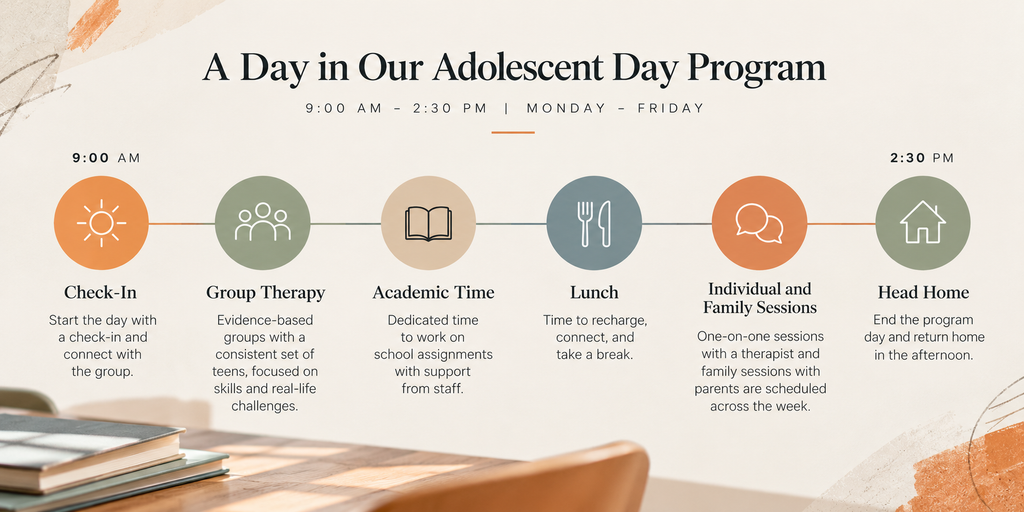
The day opens with a check-in, then moves through group therapy sessions with a consistent group of teens. Lunch is part of the day. Academic time is built in so teens keep up with schoolwork. Individual sessions with a therapist and family sessions with parents are scheduled across the week.
Groups carry most of the clinical work. They cover skills like managing difficult emotions and coping with anxiety, plus time for teens to talk through what is actually happening in their lives. Hearing peers describe the same struggles is often what reaches a teen who has not responded to adults.
The setting is less clinical than most parents expect. It feels closer to a small classroom than a hospital.
Who is a day program for?
A teen whose symptoms make a normal school day unmanageable right now, but who does not need round-the-clock care.
Common situations include a teen who has stopped attending school, a teen whose depression or anxiety has escalated despite weekly counseling, and a teen stepping down after a psychiatric hospital stay who needs continued structure before returning to a full schedule.
A day program is not the right fit for an active safety crisis. That needs emergency care first.
If your teen is in immediate danger, call or text 988 to reach the Suicide and Crisis Lifeline, or call 911.
How does school work during a day program?
This is usually the first question parents ask. A day program takes up the school day, so how a program handles academics matters a great deal.
At EQ Health, academic support is built into treatment hours. Teens work on assignments during the program day so they are not returning to a pile of missed work.
Tell the school early either way. Most districts can excuse absences and adjust deadlines during treatment. If your teen has a 504 plan or an IEP, start with the case manager. Ask the program who communicates with the school so nothing falls between the two.
How long does a day program last?
Day programs usually run for a period of weeks rather than months, with progress reviewed regularly. Length depends on how a teen responds rather than a fixed schedule.
Most teens do not go straight from a day program back to a normal week. They step down, usually to an intensive outpatient program for a few hours a day, then to weekly counseling. That gradual return is the plan from the start.
Does insurance cover a behavioral health day program?
Most commercial insurance plans cover day programs when a clinician documents medical necessity. Prior authorization is usually required before the first day, and the program typically handles that as part of admission.
When you call your insurer, ask about behavioral health benefits and name partial hospitalization specifically, since that is the term the plan will use. Ask about your deductible and coinsurance for that level of care.
EQ Health works with most insurance providers, including Aetna, Cigna, Blue Cross, and Optum.
Teen day programs in the western suburbs
EQ Health runs its adolescent day program from its Burr Ridge office, serving families in Burr Ridge, Darien, Hinsdale, Downers Grove, Lemont, and the surrounding communities.
The program runs 9:00 am to 3:00 pm, five days a week, with academic support during treatment hours and individual and family sessions included. Medication management is available through a nurse practitioner. Teens who step down continue in the morning intensive outpatient program, which lets them return to school in the afternoon, without changing providers.
Care follows the Emotional Growth Model, which builds self-awareness before coping skills. EQ Health is accredited by The Joint Commission, and assessments are free.
Frequently asked questions
Is a behavioral health day program the same as a PHP?
In most cases, yes. Partial hospitalization program is the clinical and insurance term. Day program and day treatment are the everyday names for the same level of care.
Does my teen sleep at the program?
No. Your teen comes home every evening. Day programs are outpatient care. Programs where teens stay overnight are residential or inpatient treatment.
How many hours a day is a teen day program?
Most run about six hours a day, five days a week. At EQ Health the adolescent day program runs 9:00 am to 2:30 pm.
Will my teen fall behind in school?
Not if academic support is built in. Ask any program whether teens do schoolwork during program hours and who coordinates with the school. At EQ Health, academic support is part of the treatment day.
What is the difference between behavioral health and mental health?
Very little in practice. Behavioral health is the broader term insurers and health systems use, and it usually includes substance use as well as mental health. For teen day programs the two terms describe the same care.
Does insurance cover a behavioral health day program?
Most commercial plans do when a clinician documents medical necessity. Prior authorization is usually required. Call the number on your insurance card and ask about partial hospitalization coverage by name.
Do I need a referral?
No referral is required to request an assessment at EQ Health. If a day program is recommended, the program handles insurance authorization as part of admission.
What comes after a day program?
Most teens step down to a lighter level of care. That usually means an intensive outpatient program for a few hours a day, then weekly counseling. Discharge planning sets that up before the last day.
Can my teen go to a day program after a hospital stay?
Yes, and that is one of the most common reasons teens attend. A day program gives structure and continued support between a hospital discharge and a full return to school.
EQ Health offers an adolescent behavioral health day program in Burr Ridge, IL. Call 630-366-9966 or schedule a free assessment to find out whether it is the right fit for your teen.